Monday, 21 November 2011
Recently in After Effects...
Recently in after effects with James we have been finishing off our anatomy of a murder titling, which i have had difficulties, nevertheless, i will continue trying to upload it to my blog! We have also been doing the opening of the infamous teletubbies, with the baby in the sun. This challenged us to use different elements, and using timings to move the sun up etc. I yet have this to upload also.

Friday, 11 November 2011
Cinema City
On Wednesday 9th November, our Media Class took a trip to Cimema City in Norwich to attend a short 30 minute lecture and watch Animal Kingdom.
Cinema City is Different from other Mainstream Cinemas such as Vue and Oden, mainly because its a privately owned, independent cinema, which recieves money from the council to run. Cinema City aims to show more independent, low budget or foreign films to offer the public a different sort of experience than a typical cinema. It also aims to give these small films (such as Amelie) more chance to be shown and recommended onwards. However to maintain profits, Cinema City does show a few mainstream films such as The King's Speech and Avatar, which gave then their biggest total revenue last year.
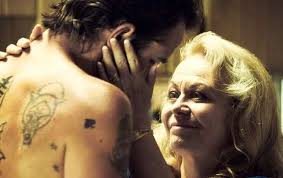 J's uncle Craig takes J for a drive and at a traffic light, a car pulls up with two young men, with one making a few hostile remarks followed with a middle finger before taking off, possibly referencing previous altercations. Craig then follows the car, handing J a handgun, to an alley, where the car stops and the man gets out, attempting to provoke a fight between himself and Craig. Instead, Craig prompts J to get out of the car and scare off the assailant. Later, Pope's best friend and partner in crime Barry 'Baz' Brown goes to meet Pope at a shopping center claiming that he wishes to quit the robbery game and settle down with his family, suggesting that Pope join him and the pair take up stock investment. As Baz goes to leave, he is encountered by police. After telling the police that Pope has left, the police shoot Baz dead. Pope and Craig want revenge, and ask J to steal a car and bring it to Darren's place. J complies, although they refuse to tell him the purpose. The car is then planted in the middle of a road. Two policemen are drawn to the scene, where they are ambushed and killed by Pope, Craig and Darren.The next day, Pope, Darren and J are arrested and taken in for questioning where J meets Detective Senior Sergeant Nathan Leckie (who also leads the armed robbery squad), who takes interest in J's situation and seeks to relieve him from it. The three are later released from custody. Later, Craig has escaped to a friend's house in regional Victoria, where he finds that he is being monitored. Despite an escape attempt, police arrive and kill Craig as he runs away. Meanwhile, J breaks up with his girlfriend Nicky at a bowling alley before Sergeant Leckie arrives and threatens to arrest him for underage drinking. Leckie takes J to a hotel, where he proposes that J be moved to a more permanent witness protection. J turns down the offer.
 The situation the intensifies more, While J is in police custody, Pope kills Nicky from an overdose of heroine, as Darren watches because he incorrectly thought she had been talking to the police. When J returns to the house the next morning after spending the night with Leckie, he discovers Nicky's bracelet outside the house. He calls Nicky, and hears her cell phone near the house and realizes that she has been killed. Pope also hears the phone and comes outside. J flees the scene, running to Nicki's parents house to escape Pope. Pope chases after him but is unable to catch J. J calls on Detective Leckie and is taken into witness protection where he presumably implicates Pope and Darren in the police officer's deaths.This triggers the arrest of Pope and Darren, who are placed in jail. With Craig and Baz dead and Pope and Darren imprisoned, Smurf decides, J needs to go, as he is the star witness in the murder case. Smurf uses her connections to procure J's address and organize a police raid on that address where J is in witness protection so that he can be shot and killed. However, J escapes when he sees armed police heading for the building. J then returns to Smurf's house, saying, "I can't live like this," and that he wishes to help free Pope and Darren from jail. To do this, the family's lawyer sets up J's answers so that a hole can be formed in the case, forcing the release of the pair from prison. Directly following the court session, Leckie visits J, asking him if he had found his place in the world.
After Pope and Darren's release, J returns to Smurf's home asking to stay. After Smurf lets him in, J goes to greet Pope and Darren before going to his room. Pope enters and begins to talk to him, but is cut off when J shoots him in the head. In the final shot of the film, J returns to the living room to embrace Smurf.
Personally, I didn't like the film, I found it very hard to follow and understand. People were carelessly getting shot for no reason, and there was no real emotion behind the characters. It was also very hard to get attached to any one individual character. It was a bit twisted in relation to the relationships within the family. I think it was very ambitious for a low budget film, however i did think that the mise on scene aspects of the film were very good.

Cinema City is Different from other Mainstream Cinemas such as Vue and Oden, mainly because its a privately owned, independent cinema, which recieves money from the council to run. Cinema City aims to show more independent, low budget or foreign films to offer the public a different sort of experience than a typical cinema. It also aims to give these small films (such as Amelie) more chance to be shown and recommended onwards. However to maintain profits, Cinema City does show a few mainstream films such as The King's Speech and Avatar, which gave then their biggest total revenue last year.
We learnt that there are six main distributors of film that distribute about 85% of films:
Warner Bros.
Paramount Pictures
20th Century Fox
Universal Studios
Buena Vista
Columbia
In our short lecture, we learnt all about the cinema industry. We started off talking about the dramatic the fall in cinema admittances since the late 1940s to now. In 1948, there were 500 million cinema admittances. In 1980, most probably due to the release of VHS, cinema admittances fell to 50 million. In 2008, it has risen though to nowhere near as high as the late 1940s - 164.2 million. The lecturer also pointed out one of the biggest sell out films which people were literally queuing round the block to see – Jaws. In 1975, Jaws was released and in 1984, the first multiplex was opened in Milton Keynes. It was based just outside the city, on cheap land, as the fixed costs were less due to the location; however it was still easily accessible. The multiple screens meant that you could sell more tickets to a larger variety of films and profits expanded. Most cinemas have peak admissions in the summer although the UK are different and usually has its peak from January to March.
The film has grossed US$4,350,187 in Australia. It is the third highest grossing Australian film at the Australian box office for 2010
ANIMAL KINGDOM
Animal Kingdom is a 2010 Australian crime drama written and directed by David Michôd, and starring Ben Mendelsohn, Joel Edgerton, Guy Pearce, Luke Ford, Sullivan Stapleton, Jacki Weaver and James Frecheville. Michôd's script was inspired by the Pettingill family of Melbourne, Australia, who in 1988 saw the acquittal of Trevor Pettingill in the murder of two Victoria police officers.
General Plot...
After his mother dies from an overdose of heroin, 17-year-old Joshua 'J' Cody asks his grandmother, Janine 'Smurf' Cody, for advice about what he should do. She invites him to move in with her, and he accepts. She is the matriarch of a notorious Melbourne crime family, further consisting of her three sons. Her eldest son is an armed robber named Andrew 'Pope' Cody, and is in hiding from a group of detectives. The middle brother, Craig, is a successful but volatile drug dealer, and youngest brother Darren follows the lead of his older brothers.After Pope and Darren's release, J returns to Smurf's home asking to stay. After Smurf lets him in, J goes to greet Pope and Darren before going to his room. Pope enters and begins to talk to him, but is cut off when J shoots him in the head. In the final shot of the film, J returns to the living room to embrace Smurf.
Personally, I didn't like the film, I found it very hard to follow and understand. People were carelessly getting shot for no reason, and there was no real emotion behind the characters. It was also very hard to get attached to any one individual character. It was a bit twisted in relation to the relationships within the family. I think it was very ambitious for a low budget film, however i did think that the mise on scene aspects of the film were very good.

Analysis Of 'The Shining'

A spectral camera soars languidly through a deep valley, conjuring up images of the American frontier, towering mountains, evergreen trees, and discouloured water captured through a wide-angle lens. Sweeping across the landscape, the camera begins to follow a tiny yellow VW Beetle making its way up a winding road carved into the steep mountain cliffs. The lens frequently moves so the the car is only in a fraction of the frame, revealing how minuscule the vehicle is against the cliff on which it is driving.
Unusually, the title sequence for The Shining also employs rolling credits, a design element normally reserved for end credits. When paired with the unsettling musical score, the austere Helvetica typeface — cryptically colored a hot blue — seems immediately at odds with the pristine wilderness.
Its all in the Titling!
In the last few lessons we have been looking at titling and how it can create a real atmosphere and idea for what the film is about. A viewer can have a good idea if what the film is about, the genre and the plot through the titling. And if its really good they can sometimes guess what then characters would be like. In class we looked at David Fincher's 'Se7en', Stanley Kubrick's 'The Shining' and Martin Scorsese's 'Taxi Driver'. We were concentrating on mostly the titlings and when and what times people like the prducers, directors, actors etc were introduced into te film through the titlings.
Taxi Driver Timeline
0.02 - Columbia Pictures Present
0.08 - Robert DeNiro In
0.35 - TAXI DRIVER 0.39 - A Bill/Phillips Production of a Martin Scorsese Film
0.42 - Jodie Foster
0.44 - Albert Brooks as Tom
0.49 - Leonard Harris
0.54 - Peter Boyle
1.07 - Music by Bernard Hermann
1.21 - David Nichols/Sandra Weintraub
1.25 - DOP Michael Chapman
1.29 - Paul Shrader
1.33 - Julia and Michael Phillips
1.41 - Directed by Martin Scorsese
The opening Credits to Se7en Consist of very eerie writting, which flashes a few times before it appears clearly, all of the titling is placed over a black and White clip, which shows a number of small clips, from close ups of small sharp knives, the chopping of fingerprints, newpaper articles, passport size photos of people which are then coloured in, and from what it looks like it all takes place with in a lab like room. For me the opening cretids of the film work really well and deffinitely set the atmosphere, and make you want to watch on, The Film Se7en is about two detectives, a rookie and a veteran, hunt a serial killer who uses the seven deadly sins as his modus operandi.
Se7en Timeline
00.04 - New line cinema presents
00.07 - An Arnold Kopelson prodution
00.11 - An film by David Fincher
00.14 - Brad Pitt
00.19 - Morgan Freeman
00.24 - SE7EN
00.31 - Gwyneth Paltrow
00.34 - Richard Roundtree
00.39 - R.Lee Ermy
00.42 - John C. McGinely
00.47 - Julie Araskog, Mark boone Junior
00.54 - John Cassini, Reginald E. Cathey, Peter Crombie
00.58 - Hawthorne James, Micheal Massey, Lelond Orser
01.04 - Richard Portnow, Richard Schiff, Pamala Tyson
01.11 - Casting by Billy Hopkins, Suzanne Smith, Kelly Borden
01.17 - Music by Howard Shore
01.22 - Costumes desgined by Micheal Kaplan
01.25 - Edited by Richard Francais Bruce
01.27 - Production Designed by Arthur Max
01.36 - Director of Photography Darius Khondji
01.41 - Co producers Stephen Brown, Nana Greenwald, Sanford Parilch
01.44 - Co-Executive Producers Lynn Hariis, Richard Saperstein
01.51 - Executive Producers Gianni Nunnari, Dan Kolsurd, Anne Kapelson
01.54 - Written by Andrew Kevin Walker
01.59 - Produced by Arnold Kopelson, Phyllis Carlyle
02. 06 Directed by David Fincher
http://watchthetitles.com/articles/00169-Se7en
Taxi Driver Timeline
0.02 - Columbia Pictures Present
0.08 - Robert DeNiro In
0.35 - TAXI DRIVER 0.39 - A Bill/Phillips Production of a Martin Scorsese Film
0.42 - Jodie Foster
0.44 - Albert Brooks as Tom
0.49 - Leonard Harris
0.54 - Peter Boyle
1.07 - Music by Bernard Hermann
1.21 - David Nichols/Sandra Weintraub
1.25 - DOP Michael Chapman
1.29 - Paul Shrader
1.33 - Julia and Michael Phillips
1.41 - Directed by Martin Scorsese
The opening Credits to Se7en Consist of very eerie writting, which flashes a few times before it appears clearly, all of the titling is placed over a black and White clip, which shows a number of small clips, from close ups of small sharp knives, the chopping of fingerprints, newpaper articles, passport size photos of people which are then coloured in, and from what it looks like it all takes place with in a lab like room. For me the opening cretids of the film work really well and deffinitely set the atmosphere, and make you want to watch on, The Film Se7en is about two detectives, a rookie and a veteran, hunt a serial killer who uses the seven deadly sins as his modus operandi.
Se7en Timeline
00.04 - New line cinema presents
00.07 - An Arnold Kopelson prodution
00.11 - An film by David Fincher
00.14 - Brad Pitt
00.19 - Morgan Freeman
00.24 - SE7EN
00.31 - Gwyneth Paltrow
00.34 - Richard Roundtree
00.39 - R.Lee Ermy
00.42 - John C. McGinely
00.47 - Julie Araskog, Mark boone Junior
00.54 - John Cassini, Reginald E. Cathey, Peter Crombie
00.58 - Hawthorne James, Micheal Massey, Lelond Orser
01.04 - Richard Portnow, Richard Schiff, Pamala Tyson
01.11 - Casting by Billy Hopkins, Suzanne Smith, Kelly Borden
01.17 - Music by Howard Shore
01.22 - Costumes desgined by Micheal Kaplan
01.25 - Edited by Richard Francais Bruce
01.27 - Production Designed by Arthur Max
01.36 - Director of Photography Darius Khondji
01.41 - Co producers Stephen Brown, Nana Greenwald, Sanford Parilch
01.44 - Co-Executive Producers Lynn Hariis, Richard Saperstein
01.51 - Executive Producers Gianni Nunnari, Dan Kolsurd, Anne Kapelson
01.54 - Written by Andrew Kevin Walker
01.59 - Produced by Arnold Kopelson, Phyllis Carlyle
02. 06 Directed by David Fincher
http://watchthetitles.com/articles/00169-Se7en
Wednesday, 2 November 2011
Technical Terms Glossary
In class today (02/11/2011) with Mr.Cole we were learning about the technical terms for various roles in the film scenes.
Camera Angles
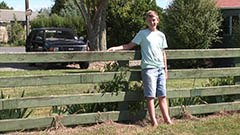
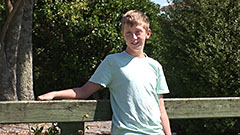
The positioning of the camera in relation to what is being shot. The camera might be at eye level or a high or low angle level.
A high angle shot is usually when the camera is located above the eyeline.


Camera Shots


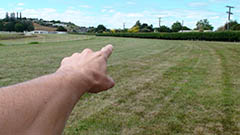
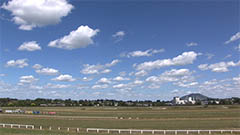
Camera Angles
The positioning of the camera in relation to what is being shot. The camera might be at eye level or a high or low angle level.
A high angle shot is usually when the camera is located above the eyeline.

In cinematography, a low-angle shot, is a shot from a camera positioned low on the vertical axis, anywhere below the eyeline, looking up. These types of shots often associate someone with power.Editing
The stage in the film making process in which sound and images are organised into a narrative.
Continuity Editing - The most common type of editing, it creates a sense of reality and time moving foreward. this technique is often reffered to as invisible editing as ot does not draw attention to the process. This process is often called Linear Narrative - where events happen chronologically.
Credits - The text at the beggining and ending of a film giving details of cast, crew etc.
Cross Cutting - The editing technique of altering, interweaving or interspersing one narrative action scene, sequence or event with another, usually in different locations. In our first piece of media coursework, we did this without even realising the real technical name behind it. By combing different scenes it suggests to the audience that the events are happening simultaneously, also know as parallel action.
Eye line match - Cutting form a character to what the character has been looking at. Alfred Hitchcock's Rear Window, for example, makes frequent use of eyeline matches http://www.youtube.com/watch?v=jswl6ux8kYY
Flashback - a scene or moment in a film which the sudience is shown an event that happened earlier. Likewise a flash forward offers the audience something that will happen in the future. Flashbacks are shown particulary well in Amoros perros and sixth sense.
Montage Editing - different shots sometimes unconnected edited together to create meaning. An example of this type of editing is in Rocky 1 - the training scene.
Fast Paced editing - Rapid succession of many shots, often less than two seconds, this type of editing emphasises tension.
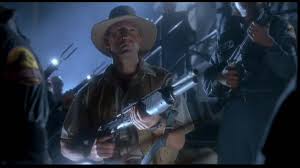
In Jurassic Park the opening scene of about two minutes fourty seconds, it consists of 46 shots. This type of editing makes the audience feel as if they have greater involvement within the film, it has a 'putting you in the situation' effect.
Slow Paced Editing - Long shots often of dialouge, up to 10 - 15 seconds each. This is a good way of showing expressions and emotion. This again is showed in Jurassic Park and yet another one of Stephen Spielberg films - shinglers list (about the hallocaust) This type of editing uses long shot, slowing zooming in to close ups.
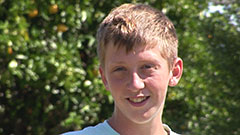
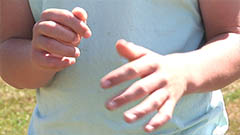
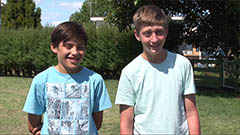
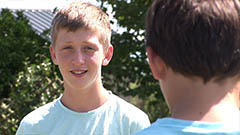
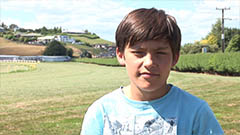
Camera Shots
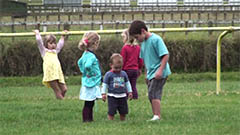
EWS (Extreme Wide Shot) the view is so far from the subject that they are not even visible. This shot is often used as an establishing shot.
VWS (very wide shot) The subject is visible (barely) but the emphasis is still on placing the subject in theor enviroment.
WS (wide shot) The subject takes up the full frame, or at least as much as possible. The same as a long shot.
MS (mid shot) shows some part of the subject in more detail whilst still giving an impression of the whole subject.
MCU (medium close up) Half way between a MS and a CU
CU (close up) A certain feature or part of the subject takes up the whole frame.
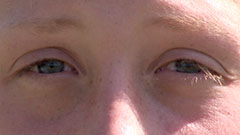
ECU (Extreme Close Up) The ECU gets right in and shows extreme detail.
CA (Cutaway) A shot of something other than the current action. This can break up a situation with in a film.
Cut-In shows some part of the subject in detail
Two Shot, A comfortable shot of two people, framed similarly to a mid shot.
OSS (Over the shoulder shot) Looking from behind a person at the subject. This is the most common shot used in everyday life, used in interviews.
Noddy Shot - usually refers to a shot of the interviewer listening and reacting to the subject, although noddies can be used in drama and other situations. This shot is usually of the interviewer.
POV (point of View shot - shows a view from the subjects perspective.
Weather shot - The subject is the weather, usually the sky. Can be used for other purposes.
SOUND:
Diegetic sound - sound that can be heard by the characters within a scene. e.g. a radio or tv being on.
Non- Diegetic sound - Sound only heard by the audience, for example, narration, sountrack or score.
Score - the musical component of the soundtrack, usually composed specifically for the scene.
Narration - A voice telling the narrative as it goes. This can be used both alongside and instead of dialouge within a scene.
Tuesday, 1 November 2011
What is a Narrator?
A narrator is, within any story the person who tells the story to the audience.
A narrator may tell the story from his own point of view or from the point of view of one of the characters in the story. The act or process of telling the particulars of a story is referred to as narration. Along with exposition, argumentation, and description, narration (broadly defined) is one of four rhetorical modes of discourse. More narrowly defined, narration is the fiction-writing mode whereby the narrator communicates directly to the reader. A writer's choice of narrator is crucial for the way a work fiction is perceived by the reader. Most narrators present their story from one of the following perspectives (called narrative modes): first-person, or third-person limited or omniscient. Generally, a first-person narrator brings greater focus on the feelings, opinions, and perceptions of a particular character in a story, and on how the character views the world and the views of other characters. If the writer's intention is to get inside the world of a character, then it is a good choice, although a third-person limited narrator is an alternative that does not require the writer to reveal all that a first-person character would know. By contrast, a third-person omniscient narrator gives a panoramic view of the world of the story, looking into many characters and into the broader background of a story. A third-person omniscient narrator can tell feelings of every character. For stories in which the context and the views of many characters are important, a third-person narrator is a better choice. However, a third-person narrator does not need to be an omnipresent guide, but instead may merely be the protagonist referring to himself in the third person
A narrator may tell the story from his own point of view or from the point of view of one of the characters in the story. The act or process of telling the particulars of a story is referred to as narration. Along with exposition, argumentation, and description, narration (broadly defined) is one of four rhetorical modes of discourse. More narrowly defined, narration is the fiction-writing mode whereby the narrator communicates directly to the reader. A writer's choice of narrator is crucial for the way a work fiction is perceived by the reader. Most narrators present their story from one of the following perspectives (called narrative modes): first-person, or third-person limited or omniscient. Generally, a first-person narrator brings greater focus on the feelings, opinions, and perceptions of a particular character in a story, and on how the character views the world and the views of other characters. If the writer's intention is to get inside the world of a character, then it is a good choice, although a third-person limited narrator is an alternative that does not require the writer to reveal all that a first-person character would know. By contrast, a third-person omniscient narrator gives a panoramic view of the world of the story, looking into many characters and into the broader background of a story. A third-person omniscient narrator can tell feelings of every character. For stories in which the context and the views of many characters are important, a third-person narrator is a better choice. However, a third-person narrator does not need to be an omnipresent guide, but instead may merely be the protagonist referring to himself in the third person
Textual Analysis Comparison of Two Films
For my media essay, I have decided to compare two films, that both go by the same name of ‘The Blob’ I decided to compare these two films as one is an original, ‘The Blob’ produced in 1958 (an independently made 1958 American horror/science-fiction film that depicts a giant amoeba-like alien that terrorizes the small community of Phoenixville, Pennsylvania) The other produced in1988 (The Blob is a 1988 American monster horror film distributed by Tristar Pictures. It is a remake of the 1958 film of the same name, which starred Steve McQueen. The film was written by Chuck Russell and Frank Darabont and directed by Russell. The shooting took place in Abbeville, Louisiana) These films, although have the same main feature are different in many aspects, this is why I decided to make a comparison of the two, that and the fact horror seemed very relevant with Halloween fast approaching. I have analysed the opening 5 minutes of each of the films.
The first obvious difference between the films is that they are both set in different places of America, and directed by different film producers. The obvious similarity is that they both have a similar plot, with the first 5 minutes in each film showing a meteorite crashing into the ground, which is then discovered to be The Blob.
In the opening scene of the 1958 film ‘The Blob’ where the titles are played we are greeted with a rather cheery up beat jazz song, which is soon joined by some repetitive lyrics, ‘beware of the blob, it creeps and leaps and glides and slides across the floor and groove the door and all around the wall, a splotch a blotch be careful of the blob’ these meant to be scary lyrics, informing and establishing what the film is about sung to a very upbeat tune are very hard to relate to a horror, and with rhyming lyrics, which most people associate with happiness, making it easy in the opening scene to forget it’s a horror. This is played over a plain black background, with red off circular shapes, which start off small, gradually getting bigger; this gives a slight illusion of hypnotism, The contrast of the happiness with the illusion are somewhat confusing, leading you into believing something dramatic will follow. This is finished off by the title ‘The Blob’ entering the screen fading in and out like a faulty light bulb, an aspect typically associated with scary situations.
In the opening scene of the 1998 film ‘The Blob’ The titles are played on a black background, which slowly shows a moving picture of the earth from space, which continues to zoom in to a particular part of a country in to a very specific street, the titles consist of dark writing, only slightly lit by an electric blue border. Blue is a very powerful colour to use and has a perception of which is evoked by light having a spectrum dominated by energy, This setting you up for something dramatic and powerful to follow. The music playing over the top in comparison to the 1958 film could not be further apart. Whereas in the original, it was an upbeat tune with lyrics, this is a very eerie sound of long, held on high pitch notes starting off quietly gradually getting louder.
In the beginning of the 1958 film, it shows a young couple, kissing, sitting in a car romantically watching the stars on a very remote hill top in the countryside on a dark summer’s night. The couple have a slight tiff or disagreement, which is an attempt to build up suspension. There is silence in between conversations where you can hear crickets in the background. pausing immediately before giving important information will increase your audience's attention. The conversation is based upon shooting stars, and in the silence the noise of a firework starts to appear, then showing what appears at first to be a comet or meteorite falling through the sky behind the dark silhouettes of trees, finally hitting the ground in the distance, resulting in smoke rapidly climbing back up into the sky. The young man and woman, remove themselves from the position of perching on the edge of car, to sitting in the seats and speeding off to see if they can find what the mysterious item was that had fallen from the sky. The following scene is of a remote house or cabin amongst many trees, with only the noise of a dog barking. The door slowly opens, where an elderly man appears, and shows a 360 view around him, from his perspective, from when the eerie music begins to play again, this time with the added extra of a stodgy bubbling sound. The man then returns into the house, which is quiet relieving being the audience because you think he’s put himself out of danger, which you desperately want because old people are associated with vulnerability. He then re appears with a lantern, and before leaving his cabin pushes his dog back in and begins to walk through the trees, following a graduated and fading glow again like a faulty light bulb accompanied by a bubbling noise. The music gets more dramatic as the elderly man gets closer to the ‘blob’ which to the eye does look like something you would expect to fall from outer space. The man then gets a stick and gently prods it, when it the mysterious item begins to crack or hatch, and its dark black shell slowly falls. The old man then repeats the prod, this time to a goo like substance, where he then picks it up on the end of a stick. As he brings the stick closer to him the goo begins to trickle down, closer to his hand, he turns the stick the other way, to prevent it from touching him, when then, the blob transfers itself onto his hand, where he is unable to remove it.
In the 1998 film, again all aspects are different, the first clear one being that it’s in a very much built up area, where as the other was in the countryside. The second difference is the seasons that it’s set in, the original is set on a summers night, in contrast this is set in the fast approaching winter season, where although this is not clear in the picture, it shows shop windows, showing signs such as ‘pre ski sale, 40 % - 50% off’ and ‘THINK SNOW. Avalanche Shooters’ whilst the eerie music is still playing this is building up suspension with the following scene showing again a deserted street, which shows an up close shot of a black cat crossing the road from right to left on a rather dark windy evening, which is believed to be a ‘bad luck’ thing in Western history, black cats have often been looked upon as a symbol of evil omens and in western and southern Europe considers the black cat as a symbol of bad luck, especially if one crosses paths with a person, which is believed to be an omen of misfortune and death. In Germany, some believe that black cats crossing a person's path from right to left, is a bad omen. In this film we are not yet introduced to any characters, whereas in the original, at this point we had already been introduced to three, this for me is a better way of making the audience more edgy as it makes you wait as it’s building up to something, as making the audience wait for something to happen makes it have a greater impact when it does so. The next clip shown is off a very big house or building, with a steeple as if it was once a church, this immediately making people think of graves and death, it then zooms or shows a closer clip of the house, following the same pattern it did as the film was starting (zooming in from space to a particular country) now looking on to part of the building behind this tall black bars, giving off a feeling of being trapped. This, followed on by clips of the church tower and the statues and gremlins that sit amongst the buildings, from her it begins to zoom out, giving an almost Birdseye view, then zooming back in again, on to a stadium with a full crowd cheering for an American football team. After scoring one player comes off, which is followed by two young boys discussing, when he will ask one of the cheer leaders out. Here, like the 1958 film it shows some resemblance to the young couple – young love theme. This is then followed on by that young American football boy, in a remote area, very much like in the original. He is with a motor bike, looking in to the distance standing on part of what is a broken bridge above a small crater or forge in the ground. He throws his coke can across the bridge before he speeds off to return in an attempt to jump the broken bridge. We then see a figure appear from the bushes and shrubbery. As the young boy is speeding back, he loses control and falls, making failure to complete the jump, when there, the figure is revealed, an elderly man and his dog. Although the scenes are very different in the two films, the characters so far are the same, even if they don’t have the same relationships with in this film. It goes back to the setting of the town in the following sequence where two more characters are introduced again, a man who is a sheriff and woman who works behind the bar, deciding on a date or a meet up. It is set in an old café/ restaurant. At this moment in time in the film, this film seems pointless, but the characters must have importance later on in the film. It is followed by bringing us back to the elderly man, who appeared to be squashing cans and throwing them into a metal bin at night, he was standing around a fire, and outside what we assume is his house/cabin in a remote area, much like the original. His trusty dog is also lying outside with him. The high pitched long notes begin to play again at this point, building up tension, the shot slowly moved up vertically showing the pitch black sky, appearing was an orange circular figure, at this point the dog began to wine or cry This adds to the tension because as we know dogs have a sixth sense and can predict bad things, he pulled away from his tethered lead, and ran. The elderly man then looks up to the sky, to see the figure fast approaching, flying over him by just a few centimetres and crashing in some trees just a few metres away. Unlike the original, the item that landed is much more exaggerated. He slowly walks over to the trees, carrying an axe, which already makes you think of something more dramatic and bigger, because in the original, he was simply carrying a stick and there, lying in the ground an item which is easily ten times bigger than the original, a brain like item, making a bubbling noise.
Subscribe to:
Posts (Atom)